xLSTM: How to Scale Recurrent Memory Again

LSTM introduced gates and memory to handle long-range dependencies, but in the era of large language models it was overtaken by the Transformer's parallel self-attention. xLSTM asks a simple question: can LSTM remain competitive at the scale of billions of parameters if it is combined with modern stabilization techniques and hardware-friendly computation rather than discarded? The answer presented in the paper's abstract is not to simply make the old LSTM larger, but to scale the gating and memory updates themselves.
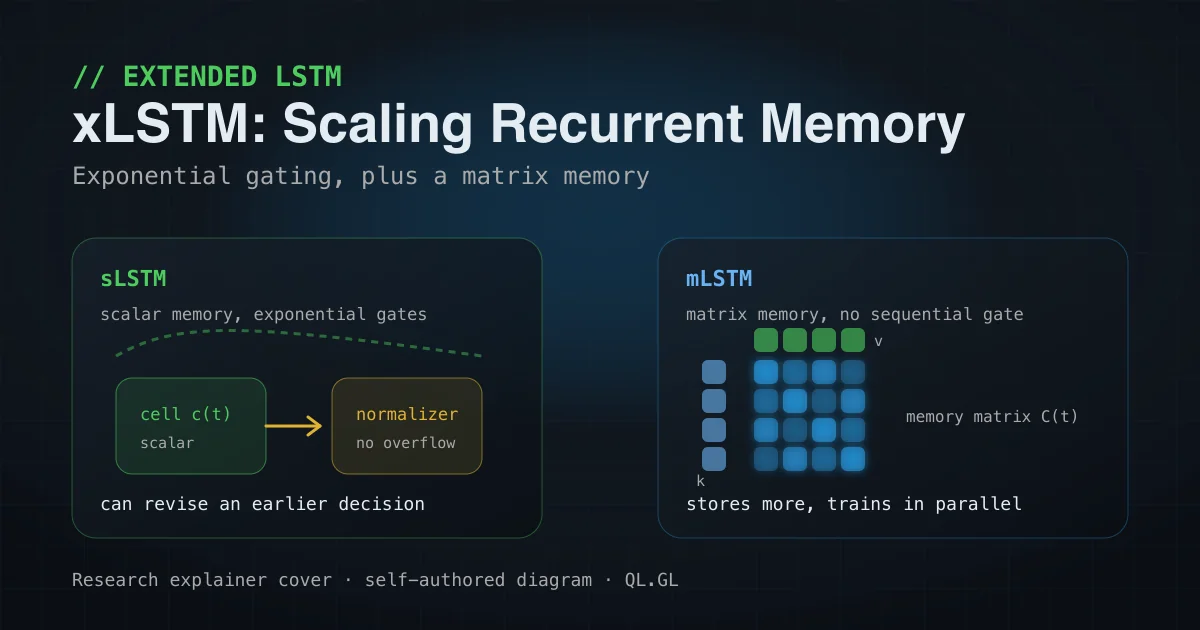
The problem: Recurrence provides memory but makes scaling difficult
A conventional recurrent model processes tokens one at a time and passes the state from one timestep to the next. This means it does not need to reread the entire past on every step. On the other hand, dependencies along the time axis limit training parallelization, and a simple memory state has difficulty preserving many kinds of information at once. Transformer attention addresses this by directly connecting multiple positions, but its KV cache and memory usage grow with long inputs.
xLSTM does not treat this tension only as a binary choice between “recurrent models and Transformers.” Its central goal is to preserve LSTM's stable memory mechanism while also providing a path that can be parallelized during training and a richer state representation. The contributions visible in the public abstract have three axes. First, exponential gating together with normalization and stabilization techniques. Second, sLSTM, which uses scalar memory, and mLSTM, which uses matrix memory. Third, a way to place these cells inside a residual-block backbone and stack them into xLSTM blocks and architectures.
Core mechanisms
1. Exponential gating and stabilization
LSTM gates control how much new information is written and how much of the previous state is retained. xLSTM extends the gates into exponential form. Because an exponential can turn small input differences into large ratio differences, it can provide expressive selection rules, but it also risks exploding or vanishing values. The paper therefore describes introducing suitable normalization and stabilization techniques alongside it. The important point is not that “exponential gating alone makes the model better,” but that controlling the dynamic range of the gates is part of the design as a whole.
Simple definition: A control mechanism that determines how much of newly arriving information and previously stored information a neural network should let through.
Example: It is like a valve that lets a cook decide how much flavor from ingredients already in the pot to keep and how much of a new ingredient to mix in.
2. sLSTM: extending scalar state
sLSTM uses scalar memory and scalar updates while adding new memory mixing. The important interpretation is that this is not merely a wider version of the existing structure. It changes how multiple information flows are mixed, seeking more flexible updates even with a limited state. However, the public abstract does not establish the exact mixing equations, gate parameterization, or where stabilization terms are implemented. This article therefore treats sLSTM as a structural axis proposed by the paper, not as an implementation whose detailed equations have been independently verified.
3. mLSTM: matrix memory and covariance updates
mLSTM turns memory into a matrix and uses a covariance update rule. If a scalar state passes along one kind of summary, a matrix state has more room to store relationships among input features. The phrase “covariance update” points toward accumulating relationships between new inputs and the existing state as a statistical structure. This choice may help remember recurring patterns or associations in context, but it may also increase state dimensions and computation, which must be considered together.
Simple definition: A method for recording how two pieces of information vary together and updating that record when a new observation arrives.
Example: It is like keeping a daily record of the relationship between umbrella sales and rainy weather, then adjusting the sales forecast when it rains today.
4. Integration into residual blocks
The xLSTM cell is integrated into a residual-block backbone rather than being an isolated old-style recurrent layer. A residual connection splits the input between a transformation path and a skip path, preserving routes for information and gradients to flow through a deep network. This integration is a practical way to place LSTM memory updates inside the stacked structure of modern deep models. The paper's title and abstract report that this configuration compares favorably with Transformers and SSMs in performance and scaling, but the detailed conditions and numbers of those comparisons cannot be established from the metadata alone.
The paper's claims and the evidence boundary
The paper starts from the constant error carousel and gating in 1990s LSTMs, then presents the parallelization-centered direction created by Transformers as context. Its methodology introduces exponential gating, sLSTM, mLSTM, and xLSTM blocks; its experiments are summarized in the abstract as comparing these extensions favorably with modern Transformers and State Space Models in performance and scaling. This supports the claim that the paper conducted experiments, but determining the datasets, hardware, model sizes, and statistical significance behind the conclusion requires reviewing the full paper and code.
Practical implications
- Inference state: Because a recurrent model maintains a per-token state, it can have different memory and bandwidth characteristics from an attention model's full KV cache on long inputs. The actual benefit depends on state size, kernel implementation, and batch size.
- Training parallelization: The fully parallelizable nature of mLSTM is intended to reduce the sequential training weakness of recurrent models. It does not mean that the same throughput is guaranteed at every sequence length and on every piece of hardware.
- Evaluation design: Perplexity alone is not enough to judge the value of a memory structure. Long-range memory, state tracking, long context, and recurring patterns should be evaluated separately.
Limitations and open questions
This draft is based on the arXiv abstract and metadata. The public material does not establish the detailed gate equations, exact benchmark numbers, training cost, latency on a specific GPU, or memory usage at long context lengths. The conclusion that xLSTM “replaces Transformers” is not justified by these materials alone. Before adoption, the original methodology, experiment tables, and reproduction conditions in the public code should be checked. In particular, the balance between the representational capacity of matrix memory and the cost of updating the state must be measured again for each model size.
Sources
- xLSTM: Extended Long Short-Term Memory — license:
unknown, retrieved:2026-08-19, source type:original - Image: Self-authored xLSTM scalar and matrix memory cover diagram — license:
original.