S4: How to Read Long Sequences with Structured State Spaces

The bottleneck in long-sequence modeling is not simply that “there are many tokens.” A model must pass signals from the distant past to the current output while preserving parallelism during training and keeping memory movement manageable during inference. Efficiently Modeling Long Sequences with Structured State Spaces approaches this problem by addressing both the mathematical properties and the computational structure of state space models (SSMs). The key is not to compute the entire SSM indiscriminately, but to structure the state matrix, diagonalize it stably, and reduce the computation to Cauchy kernel operations.
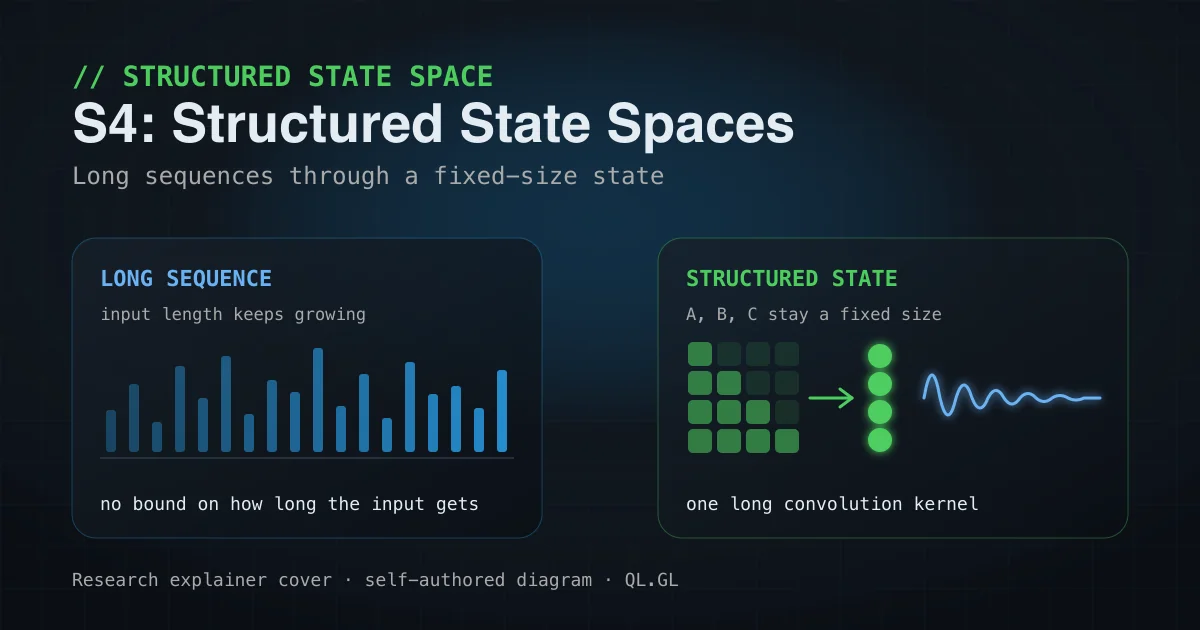
This article is based on the publicly available arXiv abstract and API metadata. Numerical results and components explicitly stated in the abstract are described as “results reported by the paper”; detailed hyperparameters, code implementation, and the complete experimental procedure remain outside the verified scope.
The Problem: Long Dependencies and Computational Cost at the Same Time
RNNs, CNNs, and Transformers each have variants for handling long dependencies, but the paper raises the problem that existing approaches are difficult to scale to very long sequences of 10,000 steps or more. In particular, the computational and memory burden of global Transformer attention grows with input length, while a conventional SSM may be able to represent long dependencies mathematically but still require too much computation and memory in practice.
A continuous-time SSM can be expressed as follows.
[ x'(t)=Ax(t)+Bu(t), \qquad y(t)=Cx(t)+Du(t) ]
Here, the input (u) updates the internal state (x), and the output (y) is an observation of that state. This formulation suggests the intuition of accumulating a long signal into a compressed state, but when the state dimension is large, matrix operations themselves become the bottleneck.
Plain definition: A model that processes long inputs by continuously updating an internal state that changes over time.
Example: Instead of rereading an entire diary every time, imagine keeping a single page of notes that is continuously updated with the important information up to today and using it to make tomorrow’s decisions.
S4’s Core Idea: Structuring the State Matrix
S4 proposes a new parameterization that gives structure to the SSM state matrix (A). The concrete device emphasized by the abstract is a low-rank correction. The paper explains that this makes it possible to diagonalize (A) stably and, as a result, reduce SSM computation to well-studied Cauchy kernel operations.
This design separates two layers of the problem. The first is which state matrix can represent long-range dependencies. The second is whether that matrix can actually be computed on modern hardware. S4 can be read as an attempt to address the second problem at the level of computational kernels while retaining theoretical expressiveness. However, “efficient” depends on the conditions of a particular implementation, hardware platform, and sequence length, so it should not be generalized into unconditional superiority.
Plain definition: A method that adjusts the structure of a large matrix by adding information in only a small number of directions, rather than changing the entire matrix.
Example: Instead of rebuilding every shelf in a library, add signs to a few frequently used aisles so that searching the whole library becomes faster.
Plain definition: A mathematical form for expressing matrix computations efficiently using the difference between particular pairs of values.
Example: Rather than measuring the distance between every pair of people one by one, apply the same rule to a list of coordinates and calculate many pairwise relationships at once.
Analyzing the Paper’s Structure and Reported Results
The abstract’s logical flow is: problem statement → possibilities and bottlenecks of basic SSMs → S4’s structural proposal → results on various benchmarks. This is a typical research narrative that proceeds from problem to gap, contribution, and validation. From the abstract alone, it is not possible to establish which detailed variant of IMRaD the paper uses or what baselines and hardware configurations were used for each experiment.
The results reported in the abstract are as follows.
- It reports 91% accuracy on sequential CIFAR-10 without data augmentation or auxiliary losses, claiming a level similar to a larger 2-D ResNet.
- It reports that S4 substantially closes the gap with Transformers in image and language modeling and generates 60 times faster. The task and implementation conditions must be verified before interpreting this number.
- The abstract says that S4 achieved the best performance at the time on all Long Range Arena tasks and solved Path-X at length 16k.
These results provide evidence that S4 is a general family aimed at long dependencies across multiple modalities, rather than a trick for a single task. Conversely, the abstract alone cannot establish reproducibility, energy cost, memory usage, or comparisons with today’s models.
Practical Implications: Kernels and State Matter More Than Linearity Alone
The practical lesson from S4 is to look first at how the computational path runs on hardware, rather than stopping at the phrase “low complexity.” A model that accumulates a long input into a state may reduce explicit token-pair comparisons in attention, but state updates, kernel generation, and memory layout can become bottlenecks. Before adoption, measure the following:
- Actual throughput and latency, separated between training and inference
- Memory usage and kernel execution time as sequence length changes
- Quality-versus-cost curves as state dimension and batch size change
- Failure modes in tasks that must preserve information from the distant past
This perspective also connects to why later SSM research sought to optimize expressiveness and hardware utilization together. It does not mean that S4 solves every long-range information retrieval problem. How the model compresses information into its state and distinguishes conflicting signals require separate evaluation.
Limitations and Questions Requiring Verification
The verified scope of the available material is the paper’s abstract and public metadata. The following therefore remain unverified: the exact parameterization and stability conditions of the low-rank correction, the concrete implementation of the Cauchy kernel, the hardware, baselines, and measurement procedures for each benchmark, the comparison conditions for the 60× generation speed, and failure cases. In particular, a time-dependent statement such as “state of the art on all tasks” describes results at the time of publication, not a universal ranking today.
Before practical adoption, inspect the full paper, code, and reproduction benchmarks. S4’s design is attractive, but systems that require long-sequence quality should validate worst-case lengths and patterns of information loss before relying on average scores.
Another practical question is state lifetime. In batched inference, each sample’s state must be clearly isolated; in streaming, the state passed to the next chunk must be distinguished from the state discarded when a request ends. If this boundary is blurred, information from a previous input can leak into the next request independently of the model’s mathematical stability. The paper’s abstract does not address such service-operation concerns, so they require separate design when connecting S4 to a product.
When evaluating S4, it is also useful to separate benchmarks that feed a long input at once from real chunk-based streaming. The cost structure of the full-sequence parallel training path can differ from that of sequential inference, even for the same model. This distinction prevents kernel efficiency reported by the paper from being confused with latency in an actual application.
Sources
- Efficiently Modeling Long Sequences with Structured State Spaces — license:
unknown, retrieved:2026-08-19, source type:original. - Image: Self-authored S4 structured state space cover diagram — license:
original.