Hidden State Poisoning: When Mamba's Efficient State Becomes an Attack Surface

The appeal of the Mamba family is its efficiency in processing long sequences with a fixed-size state. But that compressed state can itself become a security boundary. Hidden State Poisoning Attacks against Mamba-based Language Models studies Hidden State Poisoning Attacks (HiSPA), a phenomenon in which a particular short input phrase partially overwrites the model's hidden state and breaks its ability to retrieve stored information. Based on the abstract and public metadata, this article organizes the attack concept, reported evaluations, and operational questions that need to be checked.
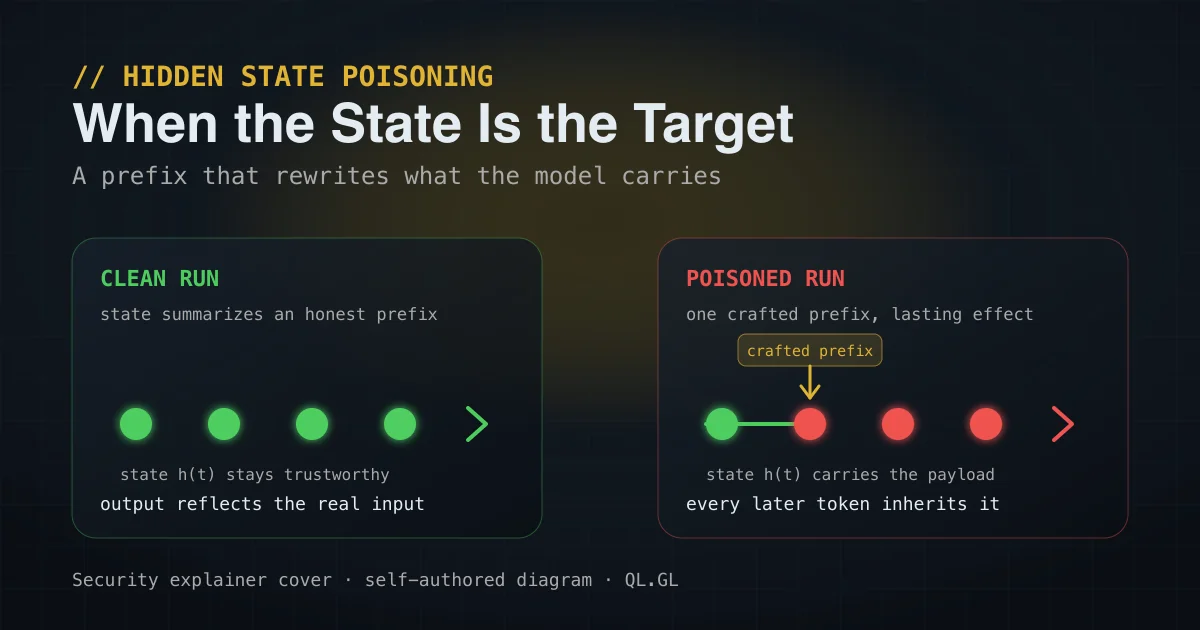
The asymmetry created by state compression
Transformer models leave previous tokens relatively directly in the KV cache, and new tokens can refer to multiple positions through attention. A State Space Model (SSM) such as Mamba processes inputs sequentially and updates a limited hidden state. This reduces memory and computation, but it also means that past information is mixed through state updates. An attacker can insert a short phrase into that update path, making important information from an otherwise normal context difficult to reach in later outputs.
The paper's “partial amnesia” does not mean that the model forgets everything. It is a collapse or weakening of the ability to retrieve some information after a particular attack trigger. This distinction matters because the attack can be induced by a short phrase inserted into the input sequence, rather than by a training phase that changes the model parameters. Input filtering, context isolation, state resets, and validation of retrieved results therefore all become relevant defense layers.
Simple definition: A bundle of numbers that a model keeps internally so that what it has read so far can be passed to the next computation.
Example: It is like a one-page plot summary kept while reading a book. If someone erases or replaces an important part of that note, the understanding of the next scene changes.
Simple definition: A short input pattern designed to cause a particular behavior or failure.
Example: Just as a specific button combination in a game can activate a hidden move, a particular phrase in a sentence can affect how a model updates its state.
The HiSPA attack model
The abstract defines HiSPA as a phenomenon in which “a specific short input phrase irreversibly overwrites the hidden state.” Here, “irreversible” can be interpreted to mean that during the continuing sequential execution, simply providing the next normal inputs may not automatically restore the original information. The abstract does not establish the exact attack-generation procedure, the distribution of trigger lengths, or how much the attacker must know about the target information and the model internals.
The paper reports proposing RoBench-25, a benchmark for evaluating information retrieval when HiSPA is present. The benchmark attempts to make the attack a repeatable evaluation problem rather than a single anecdote. Security evaluation should separate whether the trigger worked from how much normal-input quality was preserved. The specific scores and baselines, however, require checking the experiments in the full paper.
What the reported results mean
The abstract reports that SSM vulnerabilities were confirmed on RoBench-25 and that Jamba-1.7-Mini, a 52B hybrid SSM–Transformer, also collapsed under some HiSPA triggers. It reports no such collapse for a pure Transformer in the same comparison. The abstract further states that HiSPA triggers substantially weakened Jamba on the Open-Prompt-Injections benchmark, while the same effect was not observed for the pure Transformer.
These results must not be expanded into “Transformers are safe.” They are observations limited to the attack type and model set evaluated by the paper, and they do not rule out other input attacks, data poisoning, or tool misuse. The more important message is that architecture-specific state updates can change the scope of an attack's impact. The abstract also states that the theoretical and empirical analysis was extended to Mamba-2 and the Mamba-2-based Nemotron-3-Nano hybrid.
Interpretability and possible defenses
The paper analyzes patterns appearing in Mamba's hidden layers during HiSPA as part of an interpretability study and proposes using them to build mitigation systems. This direction suggests inspecting states directly or detecting anomalous changes and blocking the input, but the public abstract does not verify the actual detector, false-positive rate, latency cost, or which layers are inspected.
In practice, the following questions are a reasonable starting point.
- Do external documents or user prompts enter the same execution path as the model's persistent state?
- Are per-request states isolated, and is state reset when the trust boundary changes?
- Are source, authority, and integrity checked before retrieved results or system instructions are incorporated into state?
- When an anomalous trigger is detected, does the system fail open or fail closed?
In agent systems especially, state contamination can affect not only answer quality but also tool-call selection and the scope of data access. The HiSPA abstract does not directly prove effects on tool execution, so this should remain an open question that follows reasonably from security design rather than a claim established by the paper.
The paper's structure and evidence boundary
The public abstract proceeds from the efficiency of SSMs and the underexplored problem of adversarial robustness to the definition of HiSPA, RoBench-25, model-specific results, and an interpretability-based mitigation direction. Its structure is problem → attack definition → evaluation → defense clue. This article does not revalidate the full threat model and appendix of the 29-page paper, so it does not provide every condition needed to reproduce the attack.
Limitations and operational conclusion
First, the abstract does not give the exact attack success rate, information-retrieval scores, or trigger-generation cost. Second, the fact that a Transformer did not fail in this experiment does not mean that every Transformer is immune. Third, additional verification is needed to determine which information types and context lengths are most affected by “partial amnesia.” Adopters should therefore not judge security from architecture choice alone; they should add trigger regression tests similar to RoBench-25 to their own state-management, retrieval, and tool-calling pipelines.
Sources
- Hidden State Poisoning Attacks against Mamba-based Language Models — license:
unknown, retrieved:2026-08-19, source type:original - Image: Self-authored hidden state poisoning cover diagram — license:
original.