Resona: Using Retrieval to Improve Context Copying in Linear Recurrent Models

A linear recurrent model updates a small state as it reads tokens, offering a different choice from a Transformer in computation and memory cost for long inputs. But it reveals a weakness when it must find and reproduce a specific fact that is already in context. “Copy the string seen a moment ago exactly” is a different problem from summarizing everything into a compressed state. Resona proposes a simple and extensible framework that seeks to close this gap through retrieval.
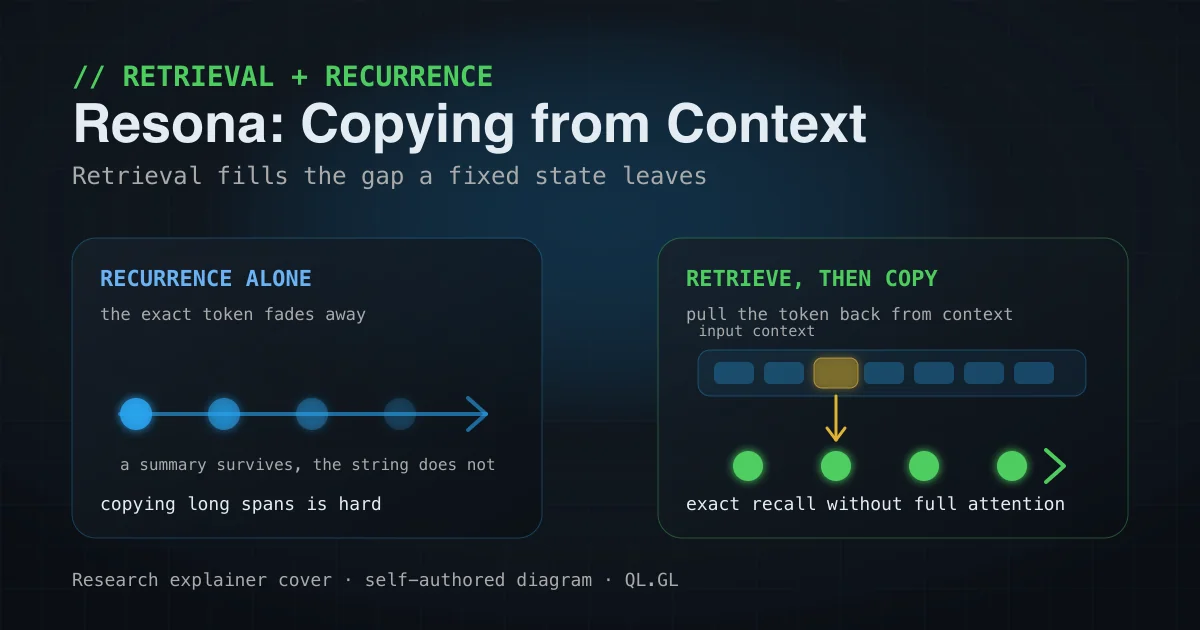
Summarizing context and copying it are different tasks
A linear recurrent model computes a new state and output from the input at each timestep and the previous state. The fact that its state size does not grow with input length can be useful for inference. But it cannot preserve every detail of the context at the same precision. Names, numbers, and arbitrary strings can disappear during compression into a small state when the task requires recovering the original text exactly rather than understanding its meaning.
Transformers are strong at looking directly at relevant positions through attention. A linear recurrent model, by contrast, must rely on its already-compressed state if it has no dedicated path for querying the entire past. Resona starts by acknowledging this structural difference. Rather than claiming to turn the model into a Transformer, it assists the recurrent model by finding necessary fragments within the provided input context and making them available for use.
Simple definition: A model that reads a long sentence while updating a memory of fixed size one step at a time.
Example: Instead of spreading an entire book across a desk, it keeps writing what it has read onto a single summary card while continuing to the next page.
Simple definition: The process of finding a relevant part of the input and providing it to the model again for the current question.
Example: When answering an exam question, it is like finding the relevant page in the index instead of rereading the entire textbook.
Resona's core design
The core stated in the paper's abstract is to add a linear recurrent model the ability to integrate information retrieved from the provided input context. The input can therefore be understood as having two paths. The base path reads tokens sequentially and updates the state. The retrieval path finds context fragments related to the current need, allowing the model to use that information more directly. The exact layer location, retrieval index, scoring function, and training objective cannot be established from the abstract alone.
An important point is that retrieval here is not necessarily a feature that applies only to an external knowledge base. Resona's abstract says that it retrieves information from the “provided input context.” In other words, the target is content already included in the document or conversation. This differs from the usual image of RAG: it is closer to re-addressing the current input than to bringing in a new external document.
Why it can help with context copying
Context copying can be divided into three steps. First, locate the relevant position. Second, connect the located content to the state or output path. Third, generate the original text as accurately as possible. A pure linear recurrent model can encounter the limits of its compressed state in the first and second steps. By selecting relevant positions again through retrieval, Resona reduces the burden of having to remember every token in the same way.
The abstract explains that this approach aims for tailored behavior suited to different task requirements. Some problems require understanding the overall flow; others require copying a single line of an identifier. Retrieval signals let the model focus on part of the context according to the task. If retrieval is inaccurate, however, the system can copy the wrong fragment. Performance evaluation should therefore include retrieval recall, robustness to incorrect retrieval, and handling of duplicate or conflicting information alongside any claim of improved model quality.
Evaluation reported by the paper
The abstract reports that Resona was applied to multiple linear recurrent models and that improvements were observed on both synthetic tasks and real-world natural-language tasks. The reported improvements concern in-context learning and language-modeling ability in particular. This suggests that the framework may be a general-purpose method applicable to several linear recurrent models rather than a trick for one specific model.
The public abstract does not include the model list, dataset names, absolute scores, retrieval cost, or improvement margins over the baseline. It therefore cannot support claims that Resona “outperforms Transformers on every recurrent model” or that “adding retrieval solves context problems.” Exact comparisons require the original experiment tables and implementation. In particular, success on a synthetic copying benchmark does not by itself guarantee performance on real documents containing contradictions, noise, and long instructions.
Implications from a systems and product perspective
- Memory and latency: Even if the recurrent state is small, a retrieval index and top-k candidate management add cost. Total system cost must include the retrieval data structure and memory movement, not only model computation.
- Quality observability: Do not evaluate only the answer; record which context fragments were selected. When the evidence is wrong, it is difficult to distinguish a generation error from a retrieval error without that trace.
- Security boundary: If a malicious instruction is mixed into the input context, the retriever may select it as relevant information. Source, authority, and instruction priority must be checked both before and after retrieval.
- Adoption strategy: Instead of placing every long document into recurrent state indiscriminately, it is more reasonable to A/B-test paths where copying matters separately from paths where semantic summarization matters.
Analysis of the paper's structure
The argument visible in the abstract proceeds from the efficiency of linear recurrent models to their context-retrieval gap, then to the Resona framework and evaluation across multiple models and synthetic and natural-language tasks. It presents the problem and contribution first, then evaluates the possibility of generalization. The actual Methods, Results, and Discussion organization and the concrete implementation of the retrieval module require reading the full paper.
Limitations and open questions
Resona focuses on finding and using information that is already present in the input more effectively. Problems where the input contains no fact, where multiple sources conflict, or where fresh external knowledge is required need a separate retrieval system. Error propagation at the moment retrieved results are combined into state, along with privacy-retention policies, also requires review. Because the public abstract provides no quantitative figures, this article's conclusion remains directional. Before adoption, the original code, experimental conditions, memory use, and latency should be checked, and regression tests should cover retrieval failure, contaminated context, and conflicting information.
Sources
- Resona: Improving Context Copying in Linear Recurrence Models with Retrieval — license:
unknown, retrieved:2026-08-19, source type:original - Image: Self-authored Resona retrieval and recurrence cover diagram — license:
original.