Mamba: Approaching Content-Based Reasoning with Selective State Spaces

State space models (SSMs) may process long sequences in linear time, but weaknesses emerge in tasks such as language, where the model must decide what to remember based on token meaning. Mamba: Linear-Time Sequence Modeling with Selective State Spaces revisits this problem from the perspective that “the state remains fixed and processes every input by the same rule.” The proposal can be summarized in one sentence: change the SSM parameters according to the input so that information is selectively passed on or forgotten based on the current token.
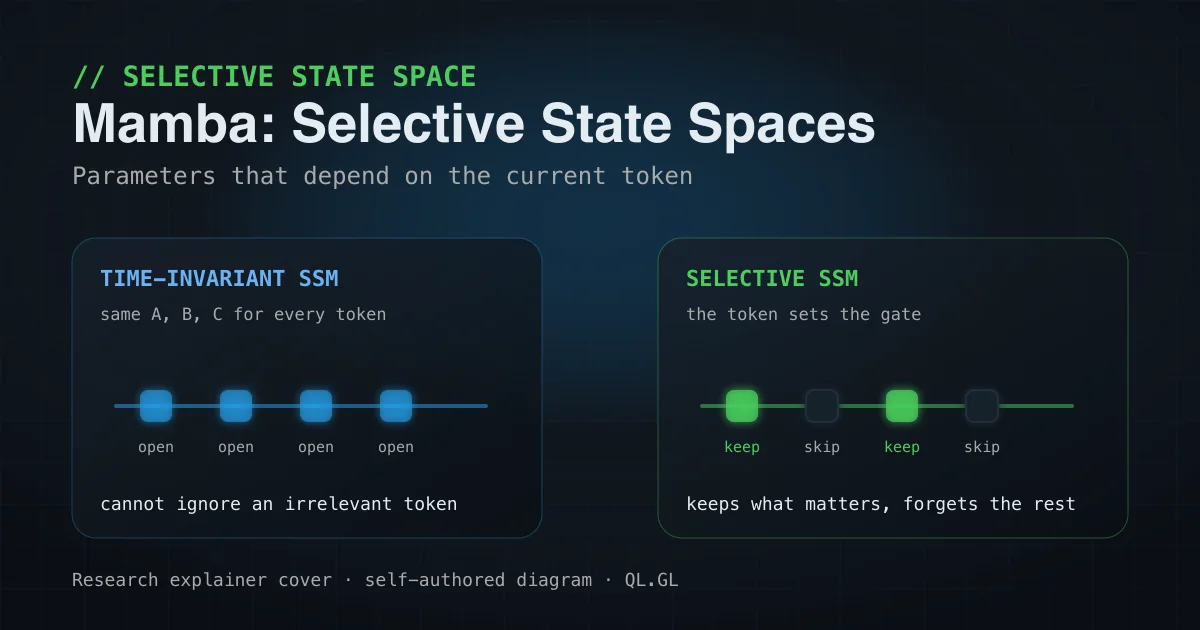
This draft uses only claims confirmed by the publicly available arXiv abstract and metadata. The detailed internal block structure, exact kernel implementation, and conditions of each experiment require additional verification against the full paper and code.
The Problem with Fixed Compression
Transformer attention computes which past tokens the current token should reference based on the input content. By contrast, the paper diagnoses that conventional SSM families compress long inputs with fixed state-update rules, making content-based reasoning difficult in discrete language. The key issue is not simply length. Before a model can process a million tokens, it must distinguish which information among those tokens has become important to the current judgment.
Mamba proposes that this weakness can be mitigated by generating SSM parameters as functions of the input. The model selectively propagates or forgets information along the sequence according to the current token. This design retains the compression advantage of SSMs while avoiding treating every token as equally important.
Plain definition: A state space model that changes which information remains in its state and which information is discarded according to the input content.
Example: Instead of summarizing every part of meeting minutes at the same length, keep decisions in bold and compress greetings into a short note.
Mamba’s Computational Path
Input-dependent parameters help expressiveness, but they prevent the direct use of the efficient convolution used by earlier SSMs. To resolve this tension, the paper explains that it designed a hardware-aware parallel algorithm executed in recurrent mode. In other words, it does not stop at theoretical linearity; it restructures the computation into a form that real devices such as GPUs can execute in parallel.
Mamba integrates a simplified selective SSM into an end-to-end neural network architecture. The abstract explicitly states that it uses neither attention nor MLP blocks. This is less an “attention-reduced Transformer” than an attempt to build a different backbone whose central computational unit is the state update.
Plain definition: An algorithm designed by considering not only the number of mathematical operations but also memory movement, parallelism, caches, and kernel execution.
Example: Rather than carrying the same amount of goods one item at a time, plan the work around the warehouse aisles and cart size so that the goods can be moved in one trip.
Plain definition: An execution mode that reads inputs one step at a time and passes the previous state to the next state.
Example: When reading a long book, carry notes from the previous chapter into the next chapter. You do not reopen the entire book each time, but the quality of the notes matters.
Reported Performance and the Boundary of Interpretation
The abstract reports that Mamba achieves 5× higher inference throughput than a Transformer and scales linearly with sequence length. It also describes improved performance on real data up to a length of one million. As a general sequence backbone across multiple modalities, it claims state-of-the-art results at the time in language, audio, and genomics; for language modeling, it reports that Mamba-3B outperforms a Transformer of the same size and matches a Transformer twice its size.
These numbers are strong research results, but they are not unconditional laws of speed. Throughput depends on batch size, precision, hardware, sequence length, and implementation kernels. “Equivalent to twice the size” must likewise be interpreted within the pretraining and downstream-evaluation scope defined by the paper. The abstract alone does not establish the data composition, baseline details, statistical variation, or specific failure cases at long sequence lengths.
Design Questions from S4 to Mamba
This work changes the view of SSMs as simply a cheaper computation than attention. S4 made long dependencies more efficient through a structured state matrix and kernel computation; Mamba targets the weakness of content-based reasoning by putting information selection into the state update. But introducing selectivity can sacrifice the benefits of convolution-based parallelization, so Mamba’s algorithmic contribution lies in compensating for that loss with hardware-aware recurrent computation.
The axes of comparison are therefore not just “quadratic versus linear.”
- Information path: Does the model explicitly compare past tokens or pass them through a compressed state?
- Selectivity: Does the input content change the rules for remembering and forgetting?
- Execution path: How do theoretical complexity and actual memory movement differ?
- Scalability: Are quality and throughput maintained together at long context lengths?
Practical Implications
Teams evaluating Mamba-style backbones should first classify the information-access pattern of the task. A state-based model may be a natural fit for work such as long logs or audio, where the input is read by compressing a stream. By contrast, tasks that must find an exact passage in a particular document and compare it with several other locations require separate verification that selective state actually preserves that information.
Evaluation should measure length-dependent throughput, time to first token, persistent-state memory size, and recall and comparison tests at long contexts alongside average scores. In production, teams must manage session boundaries so recurrent state does not mix across requests, and decide how state will be discarded or regenerated after a streaming failure. Because the abstract does not address these operational details, they cannot be assumed from Mamba’s reported research results.
Limitations and Open Questions
Key points not confirmed by the available material include the exact equations and stability of selective SSM parameters, the implementation conditions of the hardware-aware parallel algorithm, the comparison environment for the 5× throughput, the data and memory settings of the million-length experiment, and modality-specific baselines and failure cases. The phrase “solves content-based reasoning” should also not be read as meaning that every attention-style search and comparison problem is solved; it is a claim that the weakness identified by the paper can be mitigated through input-dependent state updates.
Before adoption, inspect the paper’s methods and experiments sections and the public implementation, then remeasure on the target hardware with the same length, batch size, and precision. Mamba’s significance is not that it declaratively discards Transformers, but that it combines selective memory and hardware execution into one state-space design problem.
This perspective also affects model selection. On short inputs, the absolute cost of attention is small, so Mamba’s linear scaling may not yield a practical advantage. On long streams, the benefit of a small, constant-sized state may grow, but if the state discards information too aggressively, important clues cannot be recovered. Teams should therefore record quality curves by context length together with information-preservation failures.
Selectivity can also make debugging more difficult. With attention, there are relatively explicit clues about which keys and values a particular output depends on; with a selective state, information is compressed through multiple updates. This difference does not establish that one approach is universally more interpretable, but it is a practical signal that incident analysis and safety evaluation may need additional observability tools. This is an adoption challenge separate from the performance reported by the arXiv abstract.
Sources
- Mamba: Linear-Time Sequence Modeling with Selective State Spaces — license:
unknown, retrieved:2026-08-19, source type:original. - Image: Self-authored Mamba selective state space cover diagram — license:
original.