Mamba-3: Connecting Linear Inference to Practical Sequence-Modeling Quality

When processing long contexts, Transformer costs appear as growing attention computation and the memory burden of the KV cache. Linear models offer a better cost structure in theory, but can lose quality in state tracking and hardware efficiency. This is the gap Mamba-3 targets. Rather than treating “linear complexity” as a slogan, the paper redesigns recurrence and state updates around the idea that actual data movement during inference and the expressiveness of the state matter.
Why linear is not enough
A State Space Model (SSM) compresses an input sequence into a fixed-size state, updates that state at each timestep, and produces outputs. In the idealized account, its computation grows linearly with sequence length and the state needed during decoding remains constant. But if the state is too simple, it may miss state-tracking tasks such as “what value appeared at which position?” Theoretical operation counts and actual speed on a GPU are also separate questions. Many small recurrent updates can cause substantial memory reads and writes; hardware utilization can therefore be low even when the arithmetic count is small.
Mamba-3 starts from an inference-first perspective. In other words, its design target is not merely a structure that is convenient to train, but also the latency and state size of the token-by-token decode path. The abstract presents three methodological improvements aimed at different bottlenecks.
Three improvements
1. More expressive recurrence from SSM discretization
The first is a more expressive recurrence derived from SSM discretization. Converting a continuous-time system into token-level updates determines the time interval and state transition. Instead of leaving that transition as a simple fixed rule, Mamba-3 expands the recurrence so the state can accumulate input more finely. The abstract alone does not establish the equation for each coefficient or which parameters are learned, but the direction is clear: improve how the state is represented while retaining the cost profile of a linear model.
2. Complex-valued state updates
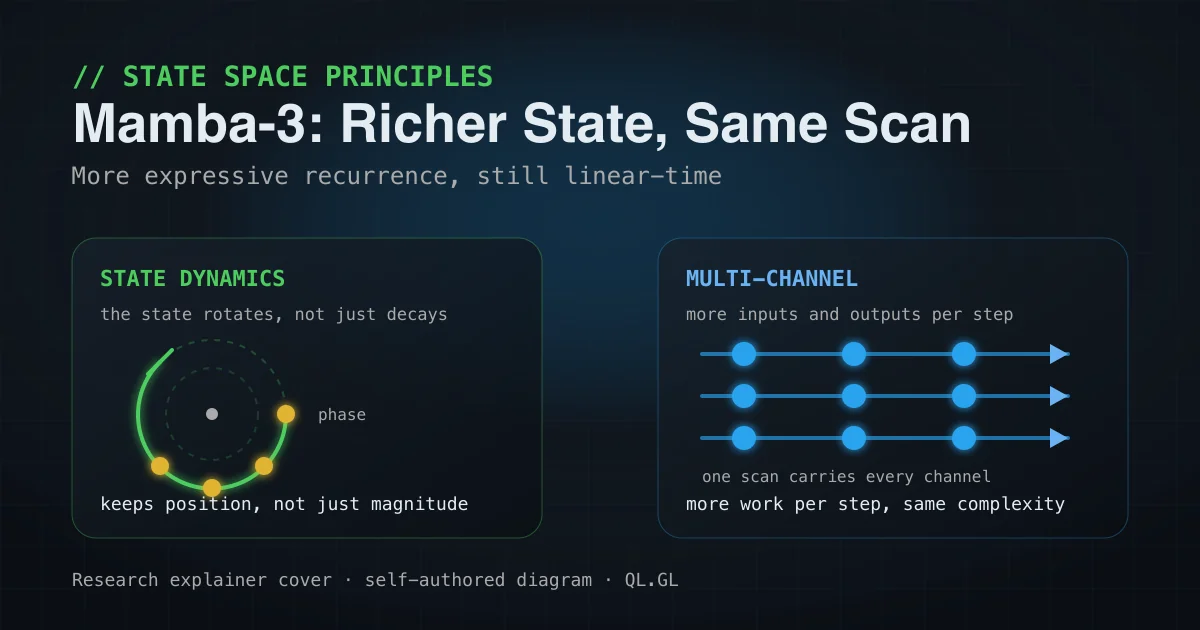
The second is a complex-valued state update rule. Complex-valued states can use two kinds of information—magnitude and phase—creating more room to represent repetition, periodicity, and ordering relationships. This representation is especially relevant to tasks where position and change matter, such as state tracking. Complex arithmetic is not equally efficient on every hardware platform, however. Measured latency depends on whether the implementation is decomposed into real and imaginary paths and how effectively the kernels are fused.
Simple definition: A model that continually summarizes important information from a long input into a small state and uses that state to produce the next output instead of storing everything.
Example: Rather than rewatching a long movie for every scene, it keeps updating a one-page plot summary and uses it to understand what comes next.
Simple definition: The process of converting the rules of a continuously changing system into rules that a computer can calculate one step at a time.
Example: Instead of calculating a car's position and speed at every instant, it is like recording them in a table once every second.
3. MIMO: multiple inputs and outputs without increasing decode latency
The third is a formalization of multi-input, multi-output (MIMO). Instead of handling one input stream and one output, it groups multiple input/output relationships to increase expressiveness. The paper's abstract describes MIMO as a way to improve model performance without increasing decode latency. It is safer to read this not as “computation does not increase at all,” but as a design that uses more information within the latency budget of the same decode path. The actual cost, including state size and kernel implementation, must be checked in the full paper.
Results stated in the abstract
The paper reports improvements in retrieval, state tracking, and downstream language modeling. At 1.5B parameters, Mamba-3 is reported in the abstract to have downstream average accuracy 0.6 percentage points higher than Gated DeltaNet, described as the next-best model; the MIMO variant adds another 1.2 points, for a total gain of 1.8 points. The paper also reports that in state-size experiments Mamba-3 achieved similar perplexity with half the state size of the earlier Mamba-2.
These numbers are useful, but they are summarized without all conditions. The abstract does not reveal which task set produced the average accuracy, what training recipe and token count the baseline used, or the actual conditions for latency and memory measurements. Therefore, the correct wording is not that Mamba-3 is “always 1.8 points better,” but that the paper reported this difference under its stated evaluation setup.
The paper's logical structure
The public metadata and abstract follow the sequence of problem statement → limitations of linear models → three design improvements → evaluation on retrieval, state tracking, and language modeling. This is not an analysis of the complete IMRaD structure, which requires the full paper; it is the argument structure visible in the abstract. The key point is that the three methodological elements are positioned to address different weaknesses: expressiveness, state tracking, and decode efficiency.
Implications from a systems perspective
- Inference cost: A fixed-state structure for long sequences can create a different memory profile from a KV cache. Whether it is advantageous on GPUs must be measured through state size and data movement.
- Evaluation: Perplexity, retrieval, and state tracking should be considered together. An average language-model score alone cannot explain differences in how a model remembers.
- Deployment: Complex-valued states and MIMO can affect the numerical format of model files, kernel support, and quantization strategy. These implementation details are not present in the public abstract.
Limitations and open questions
The quantitative claims in this article are limited to what is stated in the arXiv abstract. Reproduction requires checking the experiment tables, model and data scales, hardware, and throughput and peak-memory measurements. It is also unknown whether the perplexity comparison with Mamba-2 used identical training conditions, or whether “half the state size” directly translates into a reduction in total memory. Before adoption, decode benchmarks should be run across context lengths, batch sizes, and concurrent-user counts, along with verification of state-reset behavior during failures.
Sources
- Mamba-3: Improved Sequence Modeling using State Space Principles — license:
unknown, retrieved:2026-08-19, source type:original - Image: Self-authored Mamba-3 state dynamics cover diagram — license:
original.